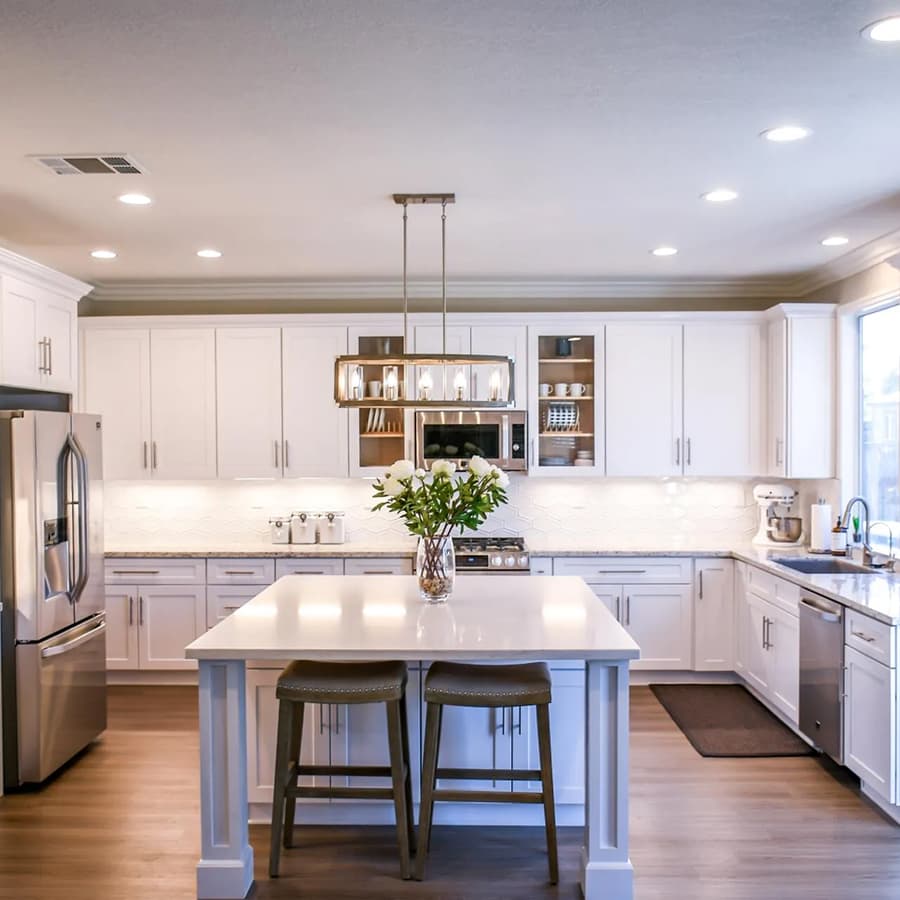
The "kitchen trends" article that surfaces on most contractor blogs is a national listicle — bold colors, smart faucets, open shelving — written without any reference to where the kitchen actually lives. In Northeast Georgia, climate, code, and the local housing stock change which of those trends are worth picking and which ones look great on Pinterest and fall apart in five years.
Here's what Gainesville, Habersham County, and Rabun County homeowners are actually choosing in 2026, why, and the trends that don't hold up to North Georgia's humidity, salt air, and afternoon thunderstorms.
What's actually showing up in 2026 NE GA kitchens
Two-tone cabinetry (perimeter + island)
The all-white kitchen that dominated 2015 through 2020 is being replaced — not by a single new color, but by a two-tone approach. Perimeter cabinets stay white or a soft warm white; the island gets the color. Deep navy, forest green, charcoal, and warm walnut stain are the four colors landing most often on Ryan's selection meetings this year.
The reason it works in North Georgia specifically: humidity-related yellowing of pure white finishes is a real problem in unconditioned-pantry adjacencies and around dishwashers. A warm white perimeter ages more gracefully than a cool stark white. The colored island gives the kitchen its identity without putting the color where it'll age first.
Quartz over granite, finally
Granite was the default counter material from 2005 through about 2018. In 2026, quartz has overtaken it in roughly 7 of 10 RCC kitchen jobs. Two reasons: quartz doesn't require annual sealing (granite does, and most NE GA homeowners never reseal until staining shows up), and quartz patterns have closed the aesthetic gap that justified granite's premium for years.
The exception: outdoor kitchens. Quartz isn't UV-stable; sun exposure yellows the binder within a few seasons. For a screened summer kitchen or an outdoor pool kitchen, granite, soapstone, or ultra-compact surface (Dekton, Neolith) is still the right call.
For a deeper comparison of finish materials, see the plaster vs pebble vs quartz pool finish guide — the same logic about humidity and weathering applies to outdoor counters.
Real-vented range hoods (not recirculating)
The recirculating range hood — the one that pulls air through a charcoal filter and blows it back into the kitchen — became standard in spec-built houses in the 2000s because it's cheap and doesn't require a roof or wall penetration. It also doesn't actually remove cooking grease or moisture, which in North Georgia humidity means kitchen cabinets above the stove get a slow film of cooking residue that nothing cleans off after a few years.
Real-vented hoods that exhaust through the roof or a side wall are the 2026 default for any kitchen remodel that touches the hood. Building inspectors in Clay and Hall are checking duct routing on every kitchen permit. Plan on $400 to $1,200 in additional cost for the duct run if the existing kitchen never had one.
Smart appliances that aren't actually smart
Wi-fi refrigerators, app-controlled ovens, smart faucets that respond to voice commands — the trend is real, but selection is shifting. In 2024 homeowners wanted everything connected. In 2026 they want the appliance to work for 15 years, and the "smart" features to fail gracefully when the manufacturer stops supporting the app (which happens to most of them within 5 years).
The smart features Ryan's clients actually use: the refrigerator water alarm, the dishwasher leak sensor, the range hood that talks to the cooktop. The ones they stop using: the touchscreen on the fridge, the recipe assistant, the auto-grocery-list.
Open shelving — only where it makes sense
Open shelving had a peak around 2019. It still shows up in 2026 kitchens, but more selectively — typically as a 2- to 3-foot section flanking a range hood, not as a wholesale cabinet replacement. The North Georgia reason: open shelves collect dust and cooking-residue film faster than closed cabinets, and the humidity makes the film harder to wipe off. A small accent stretch works. A whole wall of open shelves becomes a cleaning burden by year two.
Trends that don't age well in North Georgia
Solid wood floors directly in the kitchen
Engineered hardwood and luxury vinyl plank have both gotten good enough that solid wood in a wet zone is hard to justify. NE GA humidity cycles between 50% and 85% across the year; solid wood will gap in winter and cup in summer no matter how well it's installed. If you want the wood look in a kitchen, engineered hardwood with a moisture-stable core or LVP that genuinely looks like wood (the 2026 generation is convincing) are the durable picks.
For the related-materials angle, the bathroom tile installation mistakes guide covers the same humidity-driven failure modes for tile.
Concrete counters
Concrete had a moment in the late 2010s. The combination of North Georgia humidity, hot-pan exposure, and the fact that concrete needs annual resealing has aged most of those installs poorly. The ones still looking good are the ones with religious sealing and gentle treatment. The ones that look bad have a stain map that reads like a recipe history.
Brass / unlacquered brass everywhere
Unlacquered brass develops a "living finish" patina that some people love. In North Georgia coastal exposure (within 5 miles of the Intracoastal), the patina becomes corrosion within 18 to 36 months — the salt air accelerates it dramatically. Inland Gainesville and Habersham County houses can pull it off; Gainesville, Flowery Branch, Dahlonega, and Vilano addresses should plan on lacquered brass or PVD champagne-bronze finishes instead.
All-white shaker (still)
White shaker isn't going away — but it's no longer a "trend" worth chasing. It's a baseline. If you're picking white shaker because you saw it on HGTV last week, you're picking what the spec-builder down the street is already installing. Pick it because you actually want it, not because it's "trending."
Trends that read differently when you live here
Storm shutters' visual integration
Georgia-specific: the kitchen window often has storm shutters or impact glass. The 2026 design move is to integrate the shutter track into the trim so it doesn't read as an afterthought. A small detail, but in a kitchen where the window is over the sink, it makes a visible difference.
Generator interlock at the kitchen panel
After the last few storm seasons, more NE GA kitchen remodels are quietly adding a generator interlock kit at the panel during the kitchen electrical pull. It adds $300 to $700 to the electrical scope and gives the homeowner the ability to backfeed a portable generator into the panel for the fridge, the well pump (Habersham County), and a few outlets during outages. Not visible, but a Georgia-specific upgrade worth pricing.
Picking what's worth picking
The single biggest predictor of whether a 2026 kitchen will still feel right in 2036 isn't the color of the cabinets or the brand of the appliance — it's whether the layout serves how the household actually cooks. Trend selection comes after layout, after material durability, after code. The two-tone island, the quartz counter, the real-vented hood — those are all good 2026 picks. They're not what makes the kitchen work.
Related reading
- Kitchen Remodel Cost in Gainesville, GA (2026) — what the three remodel tiers actually cost
- Kitchen Remodel Cost & Permits in Habersham County, GA — Clay-specific cost + permit walkthrough
- Kitchen Remodel Cost & Permits in Hall County, GA — Hall-specific cost + permit walkthrough
- Choosing the Right Contractor — what to ask before signing a kitchen contract
- Kitchen Remodeling — RCC Construction — what's included in a RCC-led kitchen project
Ready when you are.
Tell me about your project — you'll see your real budget estimate mid-flow, and I'll call within 24 hours. No spam, no call center, just me.